
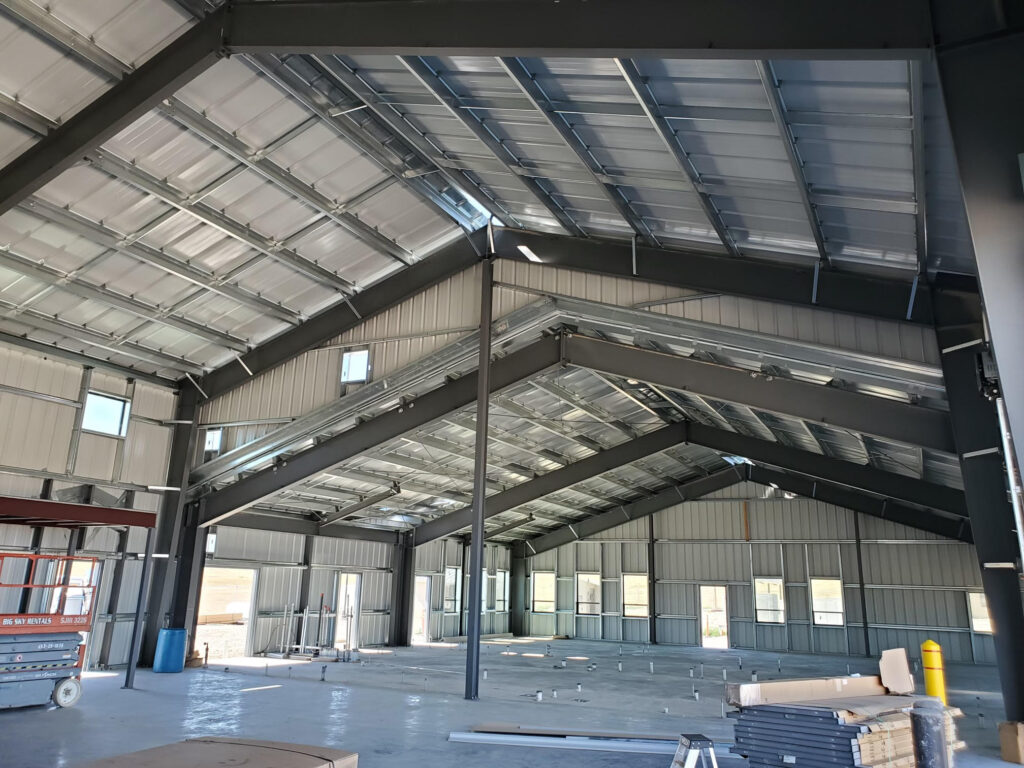
A clear-span rigid frame with a symmetrical gabled roof, delivering balanced load distribution and efficient water runoff. Ideal for facilities that require open interior space, uniform eave heights, and a classic roof profile suited for a wide range of commercial, industrial, and agricultural applications.
A clear-span rigid frame with a single roof pitch, providing efficient water drainage and flexible height distribution. Ideal for facilities that require taller eave heights on one side, attached structures, or site-specific slope requirements
A multi-span rigid frame system utilizing interior columns to support wider buildings with reduced member sizes and optimized material efficiency. Ideal for large-footprint facilities, high-load applications, or projects where expansive width, structural economy, and interior flexibility can be balanced through strategic column placement.
Hover over each component to learn more about what makes up a rigid frame structure.
Connects the structure to the designed foundation. Bears the load of the structure.
Connects the structure to the designed foundation. Supports rafters in bearing load.
Supports our purlins and roof system. Completes the frames.
Ties rafters together, supports roofing system.
Ties columns together, supports wall sheathing system.
Supports Endwall rafters and connects them to the designed foundation.
Custom openings in the building.
Custom walk door openings in the building.

Primary vertical structural member of the rigid frame, transferring roof and wall loads down to the foundation. Frame columns resist axial loads, bending, and moments generated by gravity, wind, and seismic forces.
Primary sloped or horizontal roof member forming the top chord of the rigid frame. Frame rafters span between columns and carry roof dead loads, live loads, snow, and wind forces to the frame columns.
Vertical support columns located within the building footprint for multi-span or long-bay structures. Interior columns reduce rafter spans, improve structural efficiency, and allow wider buildings with optimized member sizes.
Vertical structural members located at the building endwalls. Endwall columns support endwall framing, cladding, and loads transferred from endwall girts and headers, and may also support roof reactions depending on design.
Horizontal or sloped members at the endwall that support roof purlins and help transfer roof loads to endwall columns or rigid frames. These members stabilize the roof system at the building ends.
Secondary horizontal framing members attached to wall columns or endwall framing. Wall girts support wall panels, resist wind pressures, and transfer lateral loads into the primary structural system.
Secondary roof framing members spanning between frame rafters. Roof purlins support roof panels, distribute roof loads, and provide lateral bracing to the primary frame.
Personnel access openings integrated into the wall system. Entry doors are framed to maintain structural continuity while providing safe and convenient access for occupants.
Wall openings designed for natural light and ventilation. Windows and louvers are framed into the wall system to maintain structural integrity while improving interior comfort and airflow.
Let us know what your building needs to achieve. We’ll put it on paper.
Get inspiration for your next build. See panels installed. Check out our project gallery.
We use cookies to improve your experience on our site. By using our site, you consent to cookies.
Manage your cookie preferences below:
Essential cookies enable basic functions and are necessary for the proper function of the website.