One of the most common questions property owners ask when planning a new shop, warehouse, or agricultural building is:
“How much does a steel building cost per square foot?”
While cost per square foot can be a useful budgeting tool, it is important to understand that steel buildings are rarely priced using a single universal number.
Building size, location, snow loads, insulation requirements, and building features all influence the final project cost. Two buildings with identical square footage may have significantly different costs depending on how they are designed and where they are located.
This guide explains how cost per square foot is commonly used when budgeting for steel building projects in Idaho.
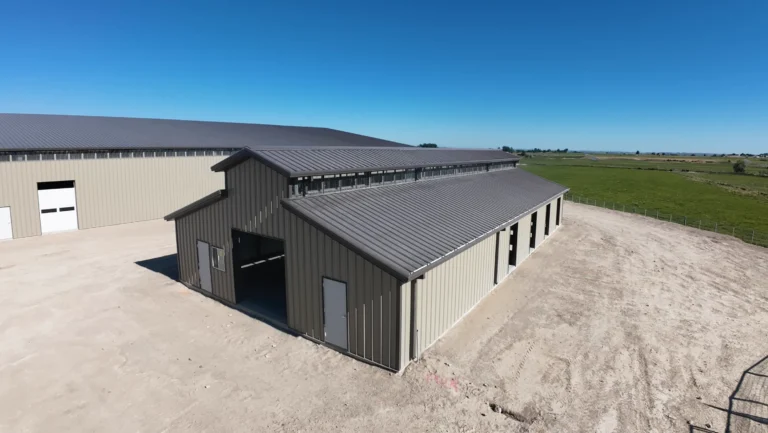
Many online articles attempt to provide a single cost-per-square-foot number for steel buildings.
The reality is much more complex.
A basic storage building with minimal openings may cost substantially less than a fully insulated commercial facility with offices, multiple overhead doors, and architectural features.
Additionally, some published figures only account for the steel building package and do not include:
Because of these variables, cost per square foot should be viewed as a budgeting tool rather than an exact project estimate.
One of the most important concepts in steel building pricing is that larger buildings often have a lower cost per square foot.
For example, a 6,000-square-foot building may not cost twice as much as a 3,000-square-foot building.
Many project costs remain relatively fixed regardless of building size, including:
As the building becomes larger, those costs are spread across more square footage.
This is why larger buildings frequently achieve better cost efficiency on a per-square-foot basis.
Many Idaho property owners begin their planning process by evaluating common building sizes and their intended uses.
Common uses include:
This size is often selected by homeowners looking for additional storage or workspace without requiring a large footprint.
Common uses include:
The 40×60 remains one of the most popular steel building sizes due to its versatility.
Common uses include:
This size provides substantial open floor space while remaining practical for many rural properties.
Common uses include:
Buildings of this size often benefit from improved cost efficiency due to their larger footprint.
Several design decisions can significantly affect overall project cost.
Idaho’s varying climate zones require different structural designs.
Projects located in areas such as McCall, Cascade, Donnelly, and other mountain communities often require heavier structural framing than projects located in lower elevation regions.
Taller buildings require additional structural steel and may increase both material and installation costs.
Many steel buildings are designed with clear span interiors that eliminate interior support columns.
While clear span construction offers tremendous flexibility, larger spans generally require heavier structural framing.
Large overhead doors, hydraulic doors, storefront systems, and other openings can influence both material quantities and structural design requirements.
Buildings intended for year-round occupancy typically require insulation packages designed for thermal performance and condensation control.
The insulation system selected can significantly affect total project cost.
When evaluating steel building costs, it is important to consider the entire project rather than focusing solely on the building package.
Additional costs may include:
For many projects, these costs represent a significant portion of the overall investment.
The best way to determine the cost of a steel building is through a project-specific evaluation.
Information that helps develop an accurate estimate includes:
With these details, building professionals can evaluate structural requirements and provide pricing tailored to the project.
There is no universal cost-per-square-foot figure that applies to every project. Costs vary based on building size, design criteria, location, and project scope.
In many cases, yes. Larger buildings often benefit from improved cost efficiency because certain fixed costs are spread across more square footage.
Yes. Buildings designed for higher snow loads generally require heavier structural framing and additional engineering.
Not always. Building packages and installation services may be quoted separately depending on the project.
Understanding cost per square foot is a helpful starting point, but every steel building project is unique. The most accurate way to budget for your project is through a customized evaluation based on your specific requirements.
Steel Building Systems provides design, supply, and installation support for steel building projects throughout Idaho. Contact our team today to discuss your project and receive a customized quote.
We use cookies to improve your experience on our site. By using our site, you consent to cookies.
Manage your cookie preferences below:
Essential cookies enable basic functions and are necessary for the proper function of the website.